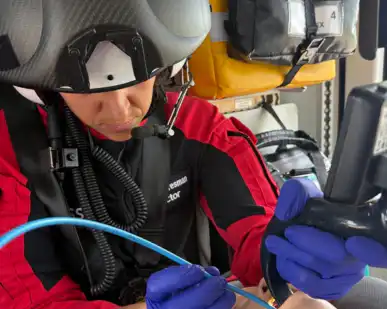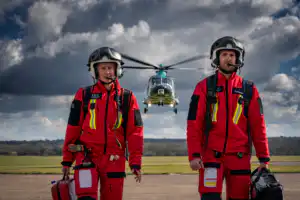
Our latest research, published this week in the Air Medical Journal, shows that in-flight Pre Hospital Emergency Anaesthesia (PHEA) similar to what is referred to as Rapid Sequence Induction (RSI) can be safely and efficiently performed in a civilian Helicopter Emergency Medical (HEMS) air ambulance, following research using high-fidelity simulation.
The study evaluated whether PHEA can be delivered during flight in an AW169 helicopter under realistic operational conditions, using high-fidelity simulation and experienced HEMS crews.
PHEA is a time critical, lifesaving, intervention used to secure the airway of critically injured patients, including those with severe traumatic brain injury to ensure adequate oxygen to the brain. Commonly, this procedure is performed on-scene before a patient is transported to hospital, a process that can extend the time it takes to get to hospital and potentially delay definitive care.
The simulated scenarios replicated a standardised traumatic brain injury patient requiring emergency anaesthesia during the flight from scene to hospital.
This new research builds on earlier KSS studies that confirmed the feasibility of performing PHEA inside a stationary AW169 helicopter cabin, including during the COVID-19 pandemic, while wearing full personal protective equipment. The latest study represents the next step, examining whether simulated PHEA can be performed during flight, rather than before take-off.
This was a planned proof of concept study and conducted in two phases; May 2023 and January 2025 during live flight conditions.
- In every simulation, the airway was successfully secured on the first attempt
- From starting the PHEA checklist to successfully confirming the breathing tube was in place was typically five minutes
- No safety events, procedural complications, or communication failures occurred
- Clinicians unanimously reported that in-flight PHEA was feasible, citing adequate cabin space, effective communication, and manageable equipment access
Allan McHenry, Specialist HEMS Paramedic and former Clinical Director at KSS, and lead contributing author, said: “National quality standards recommend that the time from the initial emergency call to PHEA should be under 45 minutes. For patients in remote or geographically peripheral locations, performing emergency anaesthesia at the scene can push beyond this target.
“Our findings show that, for carefully selected patients and with appropriately trained teams, performing PHEA during flight could offer a complementary approach, helping to reduce on scene time while maintaining procedural safety. Importantly, in-flight emergency anaesthesia is not intended to replace established practice, but to provide additional flexibility when time critical patients might otherwise face delays to definitive care when every second counts.“
“This research reflects the longstanding commitment of KSS to evidence-based innovation. By rigorously testing new ways of working through simulation we can explore how best to deliver the highest level of critical care while keeping patients and crews safe.”
To read the study click here: Feasibility of Performing Rapid Sequence Intubation During Helicopter Flight in an AW169: A High-Fidelity Pilot Simulation Study – Air Medical Journal