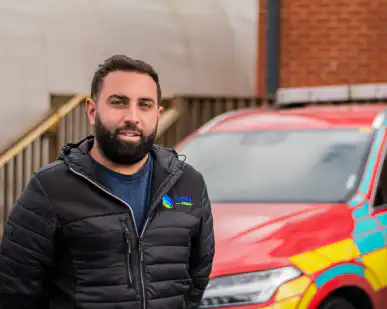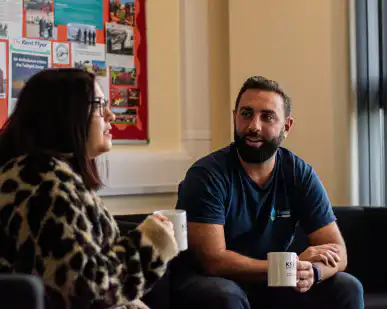
Life changed in a moment for Marcus Bawden on a cold Friday morning in 2023 as he drove to work in Sutton Vallance, Kent, via back roads that he’d used hundreds of times. This is his story.
The last thing I remember seeing was a car coming around the corner towards me at ridiculous speed and thinking ‘oh no, this is going to hit me!’. It felt like it all happened in slow motion.
I turned the wheel left to try to avoid the collision. There was a loud bang, and I woke up over the steering wheel. My car had gone through a hedge and people were screaming. I’d been cut just above my eye when I hit the windscreen, and it was bleeding really badly, so I had one eye shut and my ears were ringing from the bang.
People were trying to pull the door open, but it was buckled, so they couldn’t move it. I remember the police, fire service and paramedics from the ambulance service arriving.
I felt I was still sat in my seat as normal, but the passenger seat had gone under mine and the pedals had come up. I was sort of stuck with my knees up, but it felt normal because I could feel my toes and fingers.
Everyone was taking their turn to help me, the fire brigade, the ambulance paramedics and the air ambulance crew all working together.
Someone told me they were going to put me to sleep, and I felt warm and fuzzy. When they told me I was going to King’s College Hospital I thought things must be bad. The next thing I remember is waking up in King’s.
The vital part played by KSS
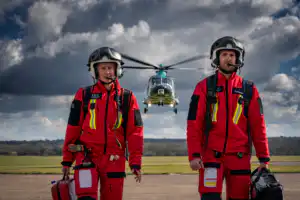
The KSS clinical team that day was comprised of KSS Doctor Jasmit Mohindru, Doctor Nick Haslam and Paramedic Stu Plumbley.
They arrived by rapid response vehicle as the helicopter couldn’t fly because of weather conditions and they had to park some distance away and walk because there were so many vehicles on the narrow lane.
KSS Paramedic Stu Plumbley recalls: “As we approached the scene we knew it was serious. There were already fire and police along with South East Coast Ambulance Service (SECAmb) present and we could see there was significant damage to the vehicle and that Marcus was trapped inside. He was awake but potentially very sick.
“We needed to get him out quickly so that we could provide further urgent care. We agreed he had probably broken his pelvis and fractured one or both of his lower limbs. If you’ve broken anything in that area you are likely to be bleeding and that puts your life at risk.
“Marcus was one of those patients who might look quite well, but you know they could potentially become critically ill very quickly when you move them because they start bleeding again.”
Doctor Nick Haslam explains: “Because we were so worried about possible internal bleeding, whilst en route we measured Marcus’s lactate levels. This is a test not available to land ambulance crews which gives us information about whether a patient needs a blood transfusion or not. We decided he didn’t need one but continued to monitor Marcus closely all the way to King’s College Hospital.”
The road to recovery
I had a couple of major operations on my broken hip and shattered pelvis. To fix the damage to the bottom of my back, they had to go in through a small slit at the front and it was quite a risky procedure because it’s near the bladder, but it all worked out. I’ve had a few more operations since then. I’ve lost some nerves in my right foot so I can’t lift it. I’ve been told it might come back in the next two years.
I was in hospital for a few weeks, but it is all a bit of a blur for me. The accident was at the end of October, and I was discharged just before Christmas.
I had to be careful because my pelvis had shattered into multiple pieces so if I damaged it again, I would be back to square one.
I still have to do physiotherapy once a week. I was sporty beforehand and played tennis and hockey, but I can’t play those now. I swim and use a bike in the gym, and I still go and watch friends play tennis and hockey.
I didn’t know that much about KSS before the incident. I remember seeing people in red at the scene and thinking they were different, but I didn’t realise they were from the air ambulance until I was in the hospital, because I was taken in a land ambulance with the KSS crew travelling with me.”
Visiting the airbase at Redhill was amazing. Like many people, my perception was that the air ambulance is a helicopter with a paramedic on board, but it is so much more – they bring their lifesaving care to your side. Learning about the set up there and what the doctor and paramedic can do for you was mind-blowing.
When I think about the crew that came to me and the air ambulance generally, the feeling I have is one that you can’t really explain. I owe everything to not just one person but to everyone that was involved, including the paramedics from SECAmb, the fire service, police and, of course, KSS.