We’re proud to announce that our Research Team has published new research in the Scandinavian Journal of Trauma, Resuscitation and Emergency Medicine examining how patients are kept under anaesthesia following pre-hospital emergency anaesthesia. The study helps address an important evidence gap in an under-researched area of pre-hospital emergency care.
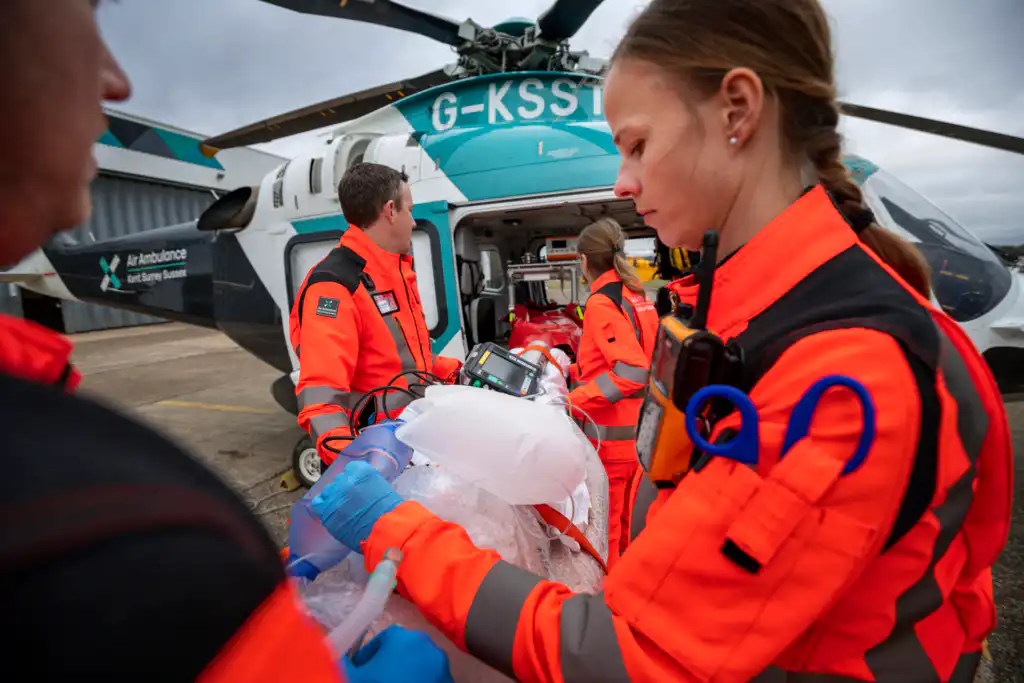
The research explored clinical practice in maintaining anaesthesia after rapid sequence induction (RSI), a procedure commonly used by helicopter emergency medical service (HEMS) teams in the UK to safely manage seriously injured patients. Despite being a routine part of pre-hospital critical care, there is currently limited published evidence examining how anaesthesia is maintained before patients reach hospital.
In hospital, anaesthesia is commonly maintained using a continuous infusion of medication. In the pre-hospital environment, however, anaesthesia has previously been maintained using intermittent doses of medication known as boluses, due to the practical challenges of delivering emergency care in locations such as at the roadside, or other out-of-hospital environments.
The study analysed data from 101 trauma patients treated by KSS between January 2019 and February 2023 and identified variation in the combination and dosing of medications used to maintain anaesthesia. The findings highlight opportunities for further research into alternative methods of anaesthesia maintenance, including continuous infusions, as well as the choice and dosing of medications used.
Doctor Brad Sheridan, former HEMS Doctor at KSS and lead author, said: “There is currently very little published evidence focused specifically on anaesthesia maintenance in the pre-hospital environment. This study provides important data from real-world clinical practice and adds to the limited evidence currently available in this area.
“The findings demonstrate variation in current practice and support the need for further research to determine the most effective methods of maintaining anaesthesia for patients requiring emergency care before reaching hospital.”
The authors hope the research will encourage other pre-hospital critical care services to review their own practice and contribute to the growing evidence base by publishing their findings, helping to build better understanding of anaesthesia maintenance.
Professor Richard Lyon MBE, Executive Director of Research and Innovation at KSS, and a co-author of the study said: “Research is central to improving outcomes for critically ill and injured patients. Studies such as this are important because they help us better understand areas of practice where evidence remains limited.
“By sharing our findings, we hope to support further research and collaboration across the pre-hospital care community, ultimately helping to inform best practice and improve patient care.”
The study was undertaken by a collaborative group of clinicians and researchers from KSS and partner organisations, reflecting a shared commitment across the pre-hospital critical care community to strengthen the evidence base for patient care.
KSS has a long-standing commitment to advancing pre-hospital emergency medicine through research and innovation. As one of the UK’s largest and busiest air ambulance charities, the organisation works closely with academic, clinical and ambulance service partners to generate evidence that improves the treatment of patients suffering major trauma and critical illness.
The charity currently responds to over 3,100 medical emergencies a year, an average of around nine every day. It costs £57k every day to run the lifesaving service, with 91% of its income raised through public support.
The full study, ‘Maintenance of prehospital anaesthesia using an intermittent bolus regime in blunt trauma patients with a high GCS and hemodynamic reserve: a retrospective cohort study’, is published in the Scandinavian Journal of Trauma, Resuscitation and Emergency Medicine and can be accessed here: Maintenance of prehospital anaesthesia using an intermittent bolus regime in blunt trauma patients …