The day before my cardiac arrest, I’d been at the gym doing a high intensity class. I felt fit, well and completely normal, in fact, I’m back to doing those classes now. I had no concerns at all.
I travelled to Gatwick on my own for our holiday to Lanzarote because my husband, Peter, was busy and flying the following day. When I arrived, my flight was delayed, so I had some lunch. When boarding was finally called, I started walking towards the gate.
That’s the last thing I remember.
The next thing I knew, it was later that evening and I was waking up in St George’s Hospital in London after suffering a cardiac arrest.
Everything else I know comes from what I was told later.
Bystander CPR
I collapsed at Gatwick Airport, and thankfully two retired Canadian nurses saw me go down. They started CPR immediately. They didn’t hesitate, they knew exactly what was happening and what to do.
Because it happened at Gatwick, there were airport staff who were trained in CPR and they responded incredibly quickly, took over doing chest compressions, and used a defibrillator on me. I was given one initial shock from the defibrillator, and when the airport’s Rescue and Firefighting Service, who are based on-site and routinely respond to medical emergencies across the airport arrived, I was shocked twice more.
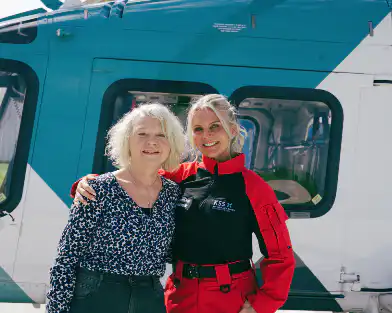
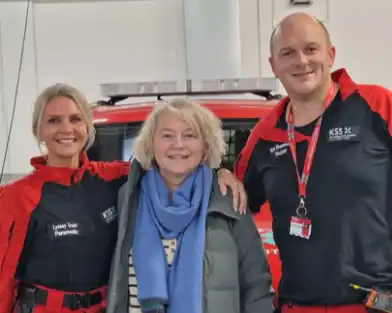
By the time the KSS critical care team arrived, my heart had started beating again. Thanks to the calm judgement and experience of Dr Rob Greenhalgh, who was the KSS HEMS Doctor on the scene with Paramedic Lynsey Grant, the decision was made not to put me into an induced coma. Instead, they lightly sedated me, giving my brain time to recover naturally.
That decision made a huge difference, not just to my recovery, but also for my family. Because I wasn’t put into an induced coma, when I arrived at St George’s Hospital I was talking. For my family, that was incredibly reassuring during what could have been a scary experience.
Recovery
I stayed in hospital for a week while doctors carried out extensive investigations, including scans and MRIs. They discovered that my cardiac arrest had been caused by scarring on my heart from a previous heart attack, scarring I didn’t even know I had.
I was eventually fitted with a Subcutaneous Implantable Cardioverter Defibrillator (S‑ICD) which sits under the skin under my arm. It is an amazing device which constantly monitors my heartbeat and can shock me if ever my heart was to need it.
I also have a monitor by my bed at home that transmits data directly to the hospital. If anything looks concerning, they contact me, it’s incredibly clever and very reassuring.
I completed the cardiac rehabilitation programme, which was brilliant. I’m back at the gym doing my high intensity workouts and I’m living my life.
Flying is different now because I can’t go through standard security scanners due to the defibrillator. I carry a card, the scanner is turned off, and I’m checked manually instead. It’s a new experience, but it’s manageable.
KSS Paramedic Lynsey Grant
“Helen’s survival is a powerful reminder of how vital early CPR is. She survived because people around her recognised what was happening and acted immediately. Cardiac arrest is not something you can make worse by trying CPR – doing something is always better than doing nothing.
“We know that women are statistically less likely to receive bystander CPR, often because people feel uncertain or hesitant about touching or undressing a woman. That hesitation can cost lives. Helen’s story shows why confidence and education around these matters so much.
KSS Doctor – Rob Greenhalgh
“What I remember most about that day is how much had already been done by the time we arrived. Decisions we make at the scene matter, but they only work when everything before them has gone right. Helen is living proof of what is possible when bystanders act, when responders are well-trained, and when a community is prepared.
What’s stayed with me most is gratitude
My survival depended entirely on the chain of survival, people recognising what was happening, starting CPR immediately, using a defibrillator, and specialist emergency medical teams, like KSS, arriving quickly. Every single person played a role. Without any one of them, I wouldn’t be here.
I was surprised to learn that women are less likely to receive early bystander CPR from members of the public and are therefore less likely to survive a cardiac arrest. In my case, it was two women, retired nurses, who saved my life without hesitation.
I see the world differently now. I appreciate life more. I feel incredibly lucky to have been given this gift back, and I want to make the most of it.
If sharing my experience helps even one person feel confident enough to step in and give CPR when it’s needed, then it’s absolutely worth it.
To meet Helen now, to hear her speak with such gratitude and generosity about her experience, is humbling. She has taken something frightening and turned it into something that will help others. That is a gift in itself.”