“On Thursday 28 April 2022, I arrived at work as normal. I was a shepherd at the time, working in Surrey on a mixed farm with land across a large part of the county. My plan was to have a coffee, feed the cows and check the sheep before my weekly drive round Surrey delivering hay and straw to horse owners.
I planned to load the big bales of hay onto a trailer. My boss’s son, Will, was then going to help me load the smaller bales on.
I got the trailer into position, detached the tractor from it and made a start. I was about six or seven feet away when I felt an almighty slap on my shoulders, neck and back.
As my body was pushed forwards, I instantly realised what was going on – I was being squashed by the stack of bales! As I tried to scramble out from underneath, there was another slap across my whole body. Suddenly, I was stuck facing the roof of the barn, trapped from the waist down. I couldn’t get my bottom onto the floor, and I was starting to panic. There was nobody else around, and in the position I was in, I couldn’t shift a bale weighing around 400kg.
My main concern was my left ankle. I tried to phone for help, but my phone was stuck.
Unable to call anyone, panic set in, and I started screaming for help like I never had before. I managed to get the attention of a dog walker passing by, but there was a barbed wire fence between us. He ran around the long way and alerted someone who lives near the barns called Dylan.
The reality of it all was now kicking in, and my hands were very tired of holding me up. My legs were going to sleep from being stuck underneath the hay, too.
Will then appeared, and together we managed to push off the bale that was on my lap. I was relieved I could finally move my right leg but, worryingly, nothing happened when I tried moving my left one.
We knew we needed to call an ambulance. We had trouble with the signal, being in a valley, but managed to get through and Dylan and I spoke to the call handler.
Fear, anxiety and disappointment were growing minute by minute. I knew something was wrong with my leg but tried to ignore the intrusive thoughts of how bad this actually was.
The unmistakable sound of a helicopter started filling the valley, growing louder and louder. I told everyone within yelling distance that if it was for me it wasn’t needed. ‘There are people out there who need them more than me’, I thought.
I don’t do hospitals, fuss or being looked after, but the level of relief and comfort I felt when the KSS crew arrived was overwhelming. I was introduced to Malcolm, my Helicopter Emergency Medical Service (HEMS) Doctor and Caroline, my HEMS Paramedic.
I don’t really remember much from this point onwards, due to drugs, shock and a sense of relief. It’s also very blurred with periods of nothingness.
I remember waking up in the helicopter three or four times and holding Caroline’s hand as tightly as I thought she’d allow me.
Another period of nothingness, and then, through the blurriness of people in hospital scrubs running around, I saw a red flight suit.
Caroline had come to say goodbye; to let me know their work was done, and it was over to the St George’s Hospital Major Trauma Team. She said the KSS crew wished me a speedy recovery. I thanked her as best as I could and we parted ways.
That moment has stayed with me throughout my recovery. It’s truly touched me emotionally, and I can’t thank Caroline enough for coming back and saying goodbye.
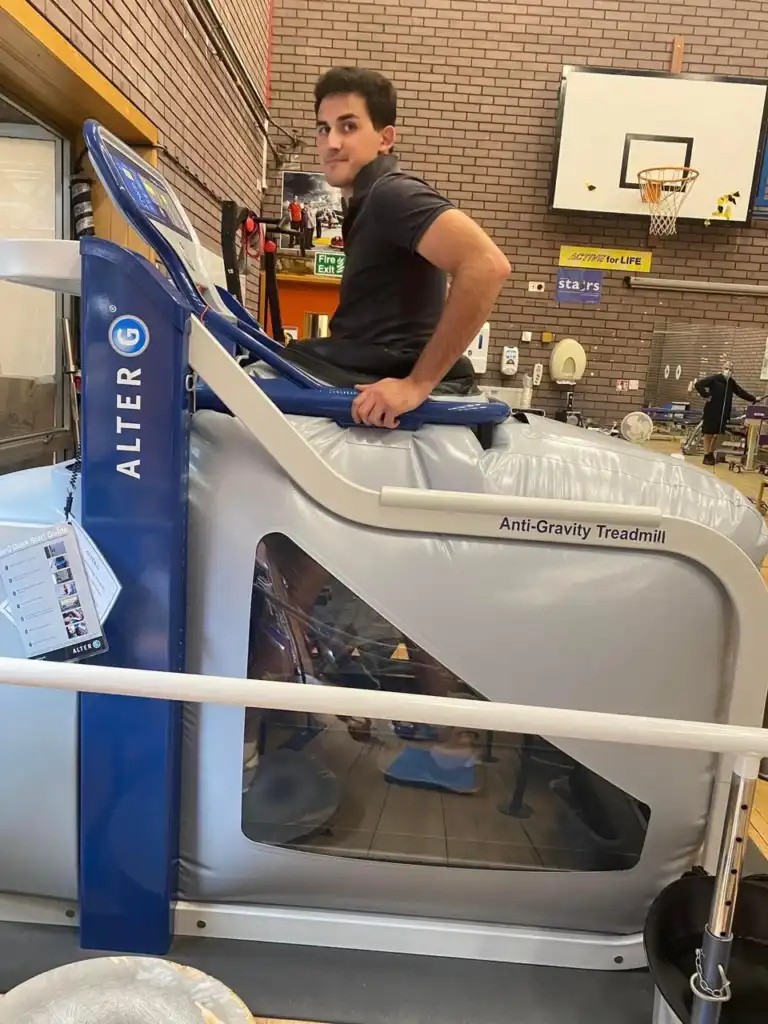
It felt like that chapter of the accident was over and now it was on to the next one of getting fixed and recovering. My left femur was stuck out the back of my pelvis and it had taken 20% of my hip socket with it. I’d fractured or broken all but two ribs on my left-hand side and to top it all, I’d broken my ankle.
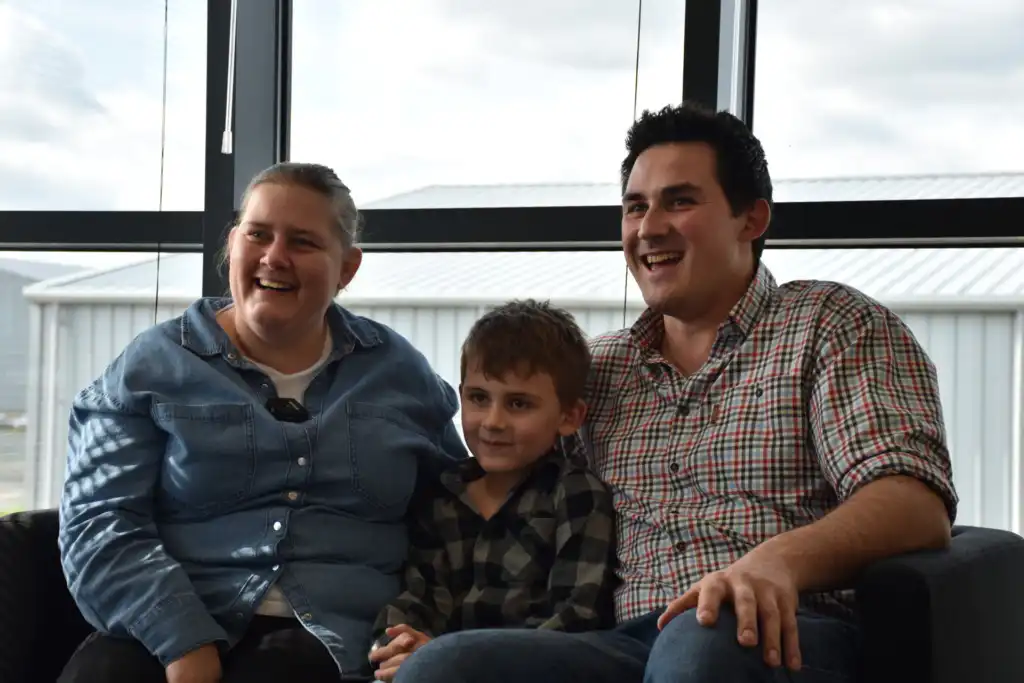
I spent six days in St George’s and was then allowed to go home because my anxiety wouldn’t settle in hospital. A decision was made to allow me home, provided my family knew the risks. I can’t thank my wife, Sophie, my parents, and my in-laws enough for everything they’ve done for me throughout my recovery.
A few months later, I asked to meet the crew who’d saved my life. Sarita and Stu from KSS’s Patient and Family Aftercare Team helped to make that possible. During my accident, Malcolm couldn’t have been more assertive and reassuringly confident, Caroline was so personable and comforting, and the pilot’s ability to operate the aircraft is phenomenal.
It was amazing to be looked after by industry-leading doctors, paramedics and pilots, but you ‘hopefully’ only need them once. The open access I’ve received to the Aftercare Team and the comfort of knowing you’ve got two people there for you when your world has turned upside down is very reassuring. I’m now really proud to be working alongside them to help educate others about the dangers that farmers face.”
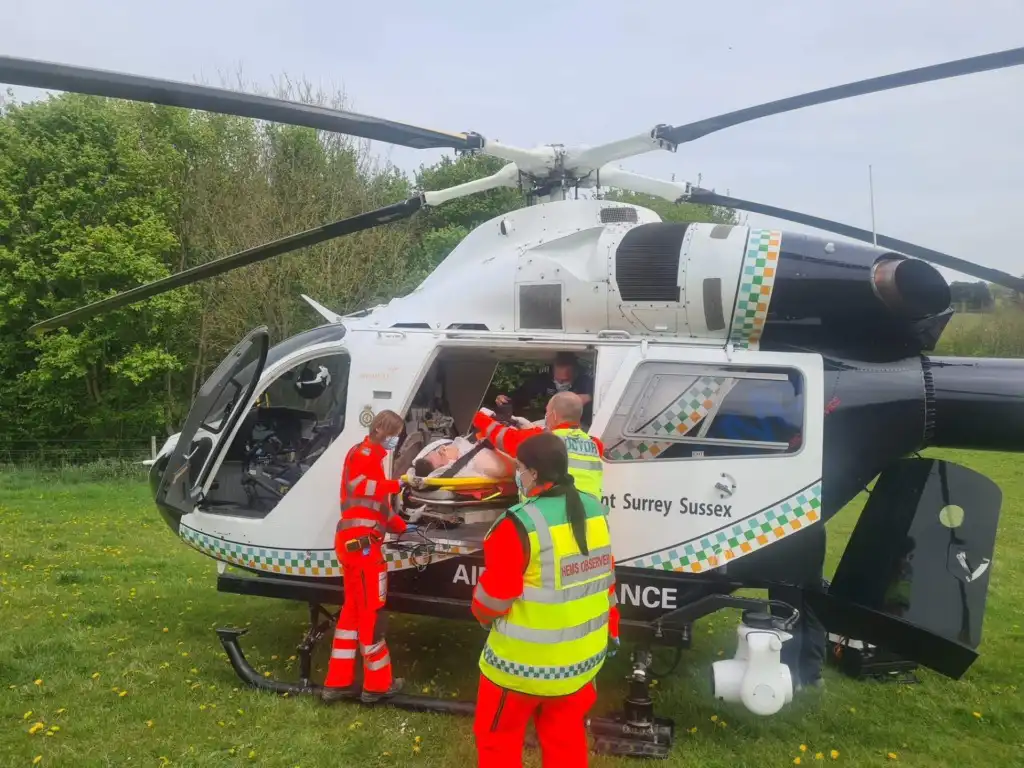
KSS HEMS Paramedic Caroline Rose: “The call was to a remote farm location in the bottom of a valley in Surrey. Due to the poor phone signal, the initial location of the 999 call was plotted some distance from the incident. It was difficult to locate from the air, but whilst orbiting above, we spotted someone flagging us down in a field. The aircraft was able to land in the field just outside of the barn and we were the first to arrive on scene.
Chris was leaning up against a hay bale, supporting his weight on his arms. The bale had been removed from his legs. He was calm and able to tell us what had happened, but it was clear he was in an immense amount of pain and unable to sit on the floor.
Our immediate priority was to administer some strong analgesia. In order to extricate Chris from the barn, we needed to lay him flat on a scoop. Due to the nature of his injuries, this would have been extremely painful. The analgesia alone was not enough and we administered further sedation in order to be able to achieve this.
It was apparent that Chris had suffered severe pelvic injuries that could be life-threatening. Chris was at risk of internal bleeding and subsequent shock. We applied a pelvic binder to help stabilise his pelvis, along with medication that would further counteract the risk of bleeding. We also applied a splint to his fractured ankle. These interventions allowed us to move Chris safely from the barn.
Along with the pilots, we carried Chris to the aircraft where we endeavoured to keep him warm and comfortable for the short flight to St George’s Major Trauma Centre in London.”
Chris and his wife Sophie first got to know the KSS Patient and Family Aftercare Team in July 2022.
Sophie recalls: “I had no idea that on that day, KSS would again change our lives for the better, this time by saving Chris from the mental trauma he was going through after his accident. Mental health amongst farmers is notoriously bad, farming is isolating and it’s more than a job, it’s a way of life.
“Stu and Sarita were able to fill in the gaps Chris had in his memory; they were able to answer our questions about what happened and why. Most importantly, they explained to Chris why he needed their help that day.
“I walked out of the KSS base at Redhill that day with part of my husband I thought I was never going to get back. Stu and Sarita – thank you for saving Chris again that day!”
You can support KSS today by playing our New Year Community Raffle: